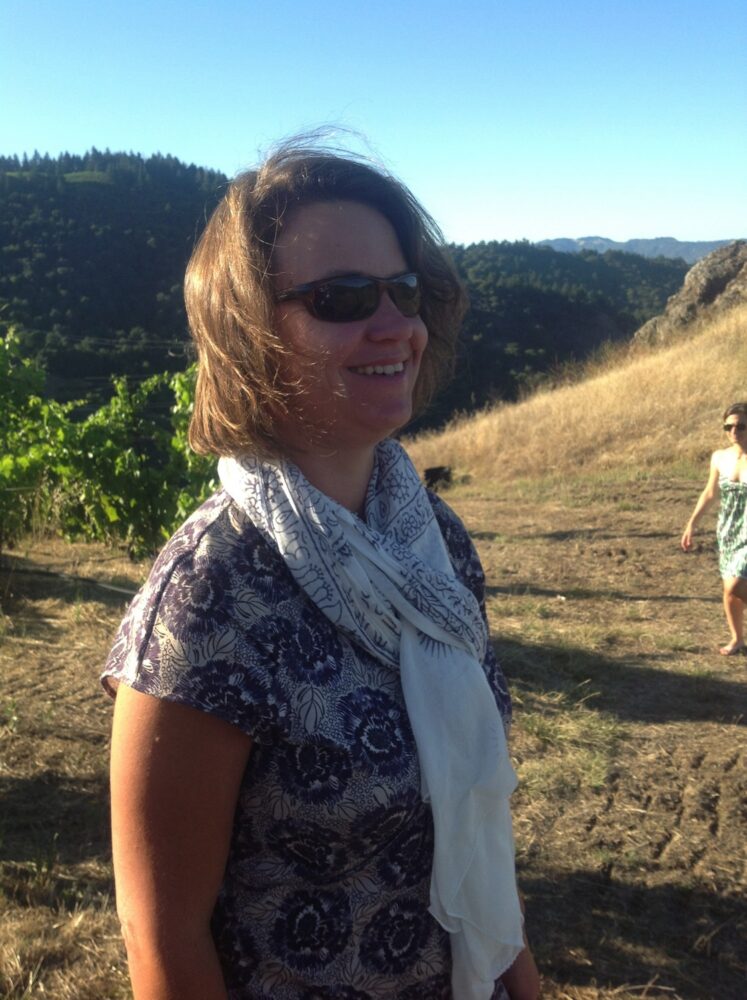

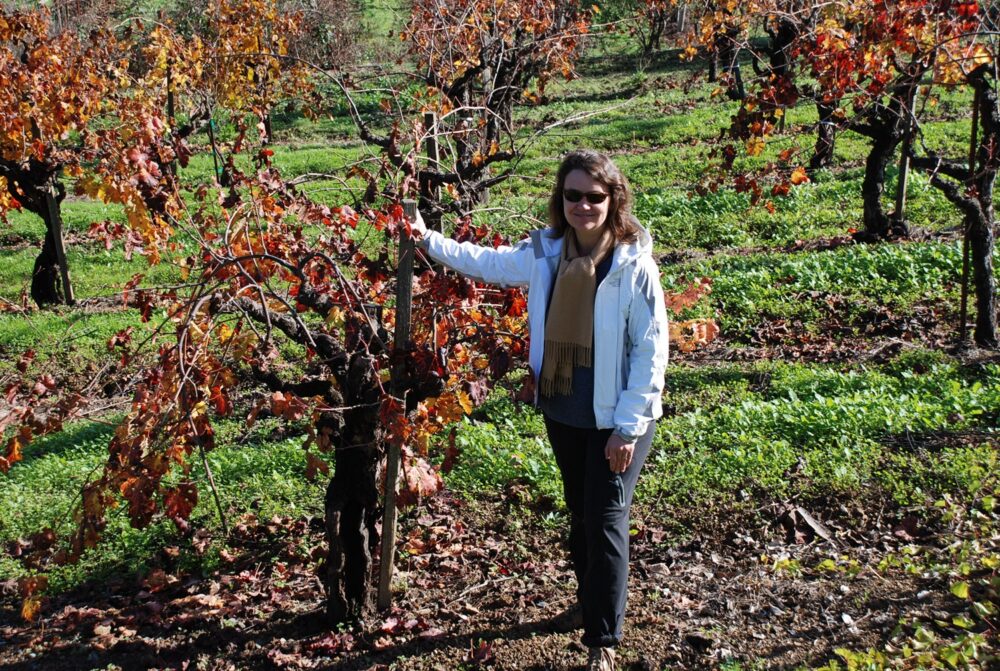
It’s nearly dusk, and wine critic and writer Virginie Boone and I are seated on a bench on Main Street in St. Helena, California. We’ll be having dinner a block over at Charlie’s Restaurant in a couple of hours, but for now we sip on cups of cold iced tea. I worry that the commotion of commerce – loud chatty tourists, trucks and cars rolling past – might be a distraction, but Boone remains unperturbed and calm. She’s a seasoned world traveler and settles back against the wooden bench like it’s her living room sofa.
A well-known and highly regarded wine critic, Boone is currently a critic at JebDunnuck.com, covering Spain and South America and domestically, Washington State as well as the California regions of Santa Cruz Mountains, Santa Lucia Highlands, Sierra Foothills, and Mendocino. Previously, Boone spent over a decade at The Wine Enthusiast, where she reviewed the wines of Napa and Sonoma. Along the way, she’s written about food and wine for The Wine Spectator, Food & Wine, and a handful of other publications. She’s long been one of the few wine critics and writers that I read for pleasure on my own time, so I was delighted when she agreed to sit down for this interview.
As traffic rolls by, Boone talks football and Taylor Swift, two subjects I don’t know a lot about but vow to explore thanks to Boone’s salt-of-the-earth demeanor and relaxed enthusiasm, which spark my curiosity about every subject she mentions.
When she was younger, Boone wanted to be a veterinarian. That was before she discovered that the sight of blood makes her faint. “Even in movies,” she tells me. “I fainted in the theater watching Saving Private Ryan.” Her love of all animals remains profound, but she has a deep affinity for dogs. She tells me that even Jane Goodall, who studied primates for most of her life, thought dogs were the most amazing animals on earth. “On her 90th birthday, she had 90 dogs at her birthday party. Dogs are the best. It’s amazing how much they tolerate us. We’re such a ridiculous species. They really put up with so much. They’ve got to think, ‘Thank goodness they feed me and take me on walks, because they’re always so fucking stressed out!’”
When it came time to figure out a career path, Boone’s only thought was, “How do I get paid to travel?” After graduating with a degree in Political Science from U.C. Berkeley, she landed a job as a contributor to the Berkeley Guides, a series of travel books published at the time by Fodor’s Travel Publications. Her first assignment was contributing to the France issue, focusing on the French Riviera and Alsace-Lorraine. Boone, whose family is French, is fluent in French and spent many childhood summers visiting family in France. She was a shoo-in for the job. Traveling on a meager per diem of $37.00 a day, and unable to accept any freebies due to strict editorial guidelines, the job was far from glamorous, but Boone loved it. “This was before laptops and cell phones. I’d have to turn in each manuscript while traveling so that I could get paid.” Boone enhanced her travels with paychecks she earned while on the road, sending editors her hand-written manuscripts via fax from DHL stores. When she was offered an editorial position by the same publication a couple of years later, she jumped at the chance. “It was fun. I got to hire writers, so I saw both ends of the process.”
Boone was offered a full scholarship as a graduate student at Stanford’s School of Journalism and took it. “I probably should have just stayed in Europe and kept traveling,” she says now, laughing. Her graduate degree opened doors for her in the magazine publishing world as managing editor for Red Herring Magazine. For a time, she enjoyed the fast pace of the publishing world, working with a large team of writers and editors and hobnobbing throughout the Bay Area, but after a while she missed writing and traveling.
“To work at Lonely Planet, that was the dream,” she tells me. So, when the Australian-based Lonely Planet travel book company needed someone to run their digital team, she applied and landed the gig. She began dividing her time between Lonely Planet’s offices in Oakland, California and their offices in Australia. “I love Australia, and they were based out of Melbourne, so I spent time there and in Sydney, the Great Barrier Reef, Tasmania.” Eventually, though, she requested writing assignments from Lonely Planet and got handed one on the Deep South.
“Lonely Planet wasn’t fluff,” she says. “They explored the culture of a place. They wanted us to go in-depth with our coverage.” She covered Louisiana and Mississippi and visited “little towns that had been hollowed out by white flight,” she says, describing the migration of white people into the suburbs and away from racially diverse towns and cities. “A lot of these once vibrant little towns had been emptied out, and it was sad to see. There’s one memory of when I was driving through Louisiana, between Monroe and Ruston, that is seared in my brain forever. This was during the David Duke era, and he was at the height of his political career. I was on a barren stretch of highway between small towns, and I saw something in the distance. I couldn’t quite make it out.” Her voice quickens and shakes a bit as she recounts this memory. “It was summer, and super-hot and humid, just gross weather. And as I get closer and closer, I finally see that it’s this guy on horseback in full confederate uniform carrying a confederate flag, just out in the middle of nowhere, galloping somewhere. I hit the gas pedal quick and got out of there.”
From there, she was assigned Guyana, which she describes as “volatile place.” Just weeks after she left the capital city of Georgetown, it was nearly burned to the ground following a violent political uprising. In Suriname (formerly Dutch Guyana), she wrote about the prevailing poverty there, the rising AIDS epidemic, and the area’s history of colonialism. “Suriname is essentially rain forest, and I hired a woman to drive me out to see a walking trail and it took us five hours of driving on these awful roads just to get there.” French Guyana is governed by French law and benefits from France’s financial support and infrastructure. “It’s like France in the tropics,” she tells me. “You can get the best coffee you’ve ever had there and great French food.”
Boone next traveled to France for Lonely Planet’s Loire Valley guide. Though she grew up around wine at the dinner table and enjoyed it, it was during the Loire Valley trip that her appreciation of wine and its culture deepened. When 9/11 happened, Boone struggled with being on the road and so far from home in Northern California, so when she was offered a position at the Santa Rosa Press Democrat, Boone jumped at the chance, landing a job covering wine for the newspaper. “I think part of the reason I got hired at the Press Democrat was because the New York Times, which owned it back then, had started a food and wine magazine called Savor, and they wanted somebody with magazine experience and a travel writing background.” There is a nostalgic tone in her voice when she recalls her workload at the time: one feature a week. That still seems like a lot to me, but Boone’s hardworking nature is perhaps matched only by her deep curiosity.
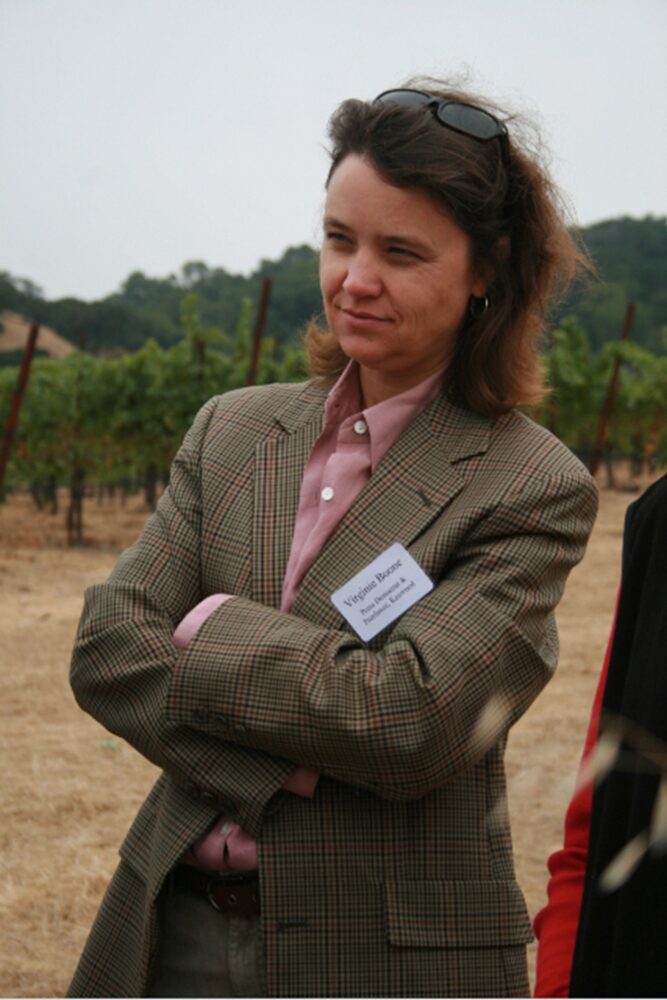
She became a nationally recognized wine critic when she began scoring wines for The Wine Enthusiast, where for over a decade she reviewed the wines of Napa and Sonoma. Applying a score to a wine requires, among other things, a deeply educated palate, tremendous stamina, and an ability to remain uber-focused for impossibly long hours.
Now at JebDunnuck.com, she tells me, “I wouldn’t have wanted to work for anyone else in the critic space. I’ve always respected the way he handles his business, and his love for wine is pure and simple.” I’m curious as to how she landed her current position. “Essentially, a winemaker I’ve known for a long time let me know that Jeb might be looking for another reviewer. I reached out and told him I might be interested. We had a few conversations and before you knew it, I was invited to join the team. It’s been a thrilling ride, lots to learn, lots of travel, and new people.”
Perhaps relying on her chops as a travel writer, her regional reports are enriched by her broad coverage of the region at hand. When I ask her what it’s like to review wines for a region like the Sierra Foothills, for example, that may not be as well known as the Napa Valley, she smiles broadly. “I love having conversations with people about their region, the history of it. Meeting all the personalities that make up a winegrowing region. And it’s like anything. It can get to be a grind sometimes, but if you really love it, you can always find something about it to appreciate. I find the value in whatever I’m tasting whether I personally like it or not. I can recognize that something is well made even if it doesn’t appeal to my personal palate. And I’m not going to dump on something just because it’s made with a certain grape variety or at a certain alcohol level. Sure, there are things I get excited about that I will give a high score, but I want to be trustworthy and considered fair. I don’t want to be someone with an agenda; a critic who always hates this or that kind of wine. If you have already made your mind up about a wine before you’ve tasted it, based upon the label or whatever, then I just don’t think that’s the ideal approach for a wine critic.”
When I ask Boone if she’s worried about wine culture in the United States, she says, “We don’t have a wine culture here. We have pockets here and there, but we still don’t think of wine as food here, or as something to have on the table with dinner. The wine business has suffered from the lack of business and marketing acumen, and a lack of collaboration and cohesiveness in looking at ourselves as a united industry. Some people are totally self-made, and they’ve been doing this all their life, and they farm their own grapes and they’re deeply invested. Then there are others who started a winery just because they want to look cool, live in a wine region, and have a little side business. Maybe this is our moment to grow up as an industry. Who’s in it for real? Who’s really going to put in the time, effort, and money into this long-term and embrace the business aspect of wine?” She saves her worry for farmers, whom she says have the greatest challenges due to climate change and a shortage of labor.
Boone balks at new brands that come out with expensive wines just because they’re in a region that can command certain price points. Instead, she points to brands like Drew in Mendocino County who have been making wine for years, but who continue to evolve their lineup of wines, having recently come out with a new Mendocino County-designated Pinot Noir at $27.00 a bottle. “Their attitude is, hey, we’ve been here for a lot of years, but there are still people who have never heard of us. Let’s come out with something competitively priced that we can get into distribution. And the wine is delicious.”
As dusk falls around us, we head out toward Charlie’s Restaurant, but there’s one stop that Boone wants to make first. Always the curious traveler, she wants me to know about the best place for pie in St. Helena. It’s not, I find out, a fancy bakery or one of the town’s numerous restaurants. Nope. Instead, I follow Boone through the front doors of Steve’s Hardware, an old emporium featuring everything from garden hoses and shovels to fishing poles and tackle boxes. We make our way all the way to the back of the store, and soon we’re standing over a freezer of all kinds of pies…berry, peach, apple. “These are the best pies in the valley,” she says, before making a beeline for the back door like she’s been there a hundred times before.