

”In the end, all collaborations are love stories.”
– Twyla Tharp
Ask any winemaker what their favorite time of the year is at work, and any one of them worth their salt will answer: harvest. Ask any winemaker what the most stressful, challenging and physically taxing time of year is, and if they’re hands on, they’ll give you the same answer. One thing they love about harvest is that it doesn’t happen in a vacuum. It’s a highly collaborative process, and more than any other time of the year, it’s when cellar teams really bond with one another. And that’s what any great winemaker is during this time of year: part of the harvest crew.
7:30 AM
I’m driving north on Hwy. 29 in Napa Valley to shadow a harvest crew. The misty morning sky is punctuated here and there with colorful hot air balloons, ascending above vineyards. I’m well accompanied by Keith Jarrett’s Koln Concert on the car stereo, a hot cup of coffee and an apple fritter from Butter Cream Bakery in downtown Napa.
I chose to shadow Realm Cellars because they are as much an outlier in the Napa Valley as they are the very embodiment of what makes the valley matchless. There isn’t just one Napa Valley when it comes to viticultural expression. Its sixteen appellations, ranging from 2,600 feet in elevation to sea level (20 to 500 feet), reflect an amalgamation of tectonic wonder, mysterious Underland and a climatically charged biodiversity that, when present in its finest, truest wines, captivates the palate and stirs the soul. To capture some of that Napa Valley magic, Realm has established three production facilities across the valley: Realm North in Calistoga, the Houyi Estate up on Pritchard Hill, and the Moonracer Estate in the Stag’s Leap District, under the shadow of Wappo Hill. In addition to their own estate vineyards – the Farella Estate in Coombsville; Moonracer and Hartwell XX in the Stag’s Leap District; and the Houyi Estate on Pritchard Hill – Realm sources from such storied designates as Dr. Crane, To Kalon, Beckstoffer Bourn, Blair, and Larkmead.
At a time when too many wineries in the valley are trying to communicate a certain wine lifestyle, Realm Cellars is all about wine as a way of life. Its culture erupts from its vineyard sources, and – nice architecture and pleasing aesthetics aside – that’s what seems to matter most to the Realm team. The vineyards are the muses that drive everything else they do.
Realm Cellars is not a brand trying to define itself as much as it is a project allowing itself to be carried forth by its wines and the symbiotic relationship that emerges between these wines and the audience that seeks them out. Like all great wine estates of the world, it is revealed to itself as much as to the world, through time and engagement, and ultimately, intentional stewardship.
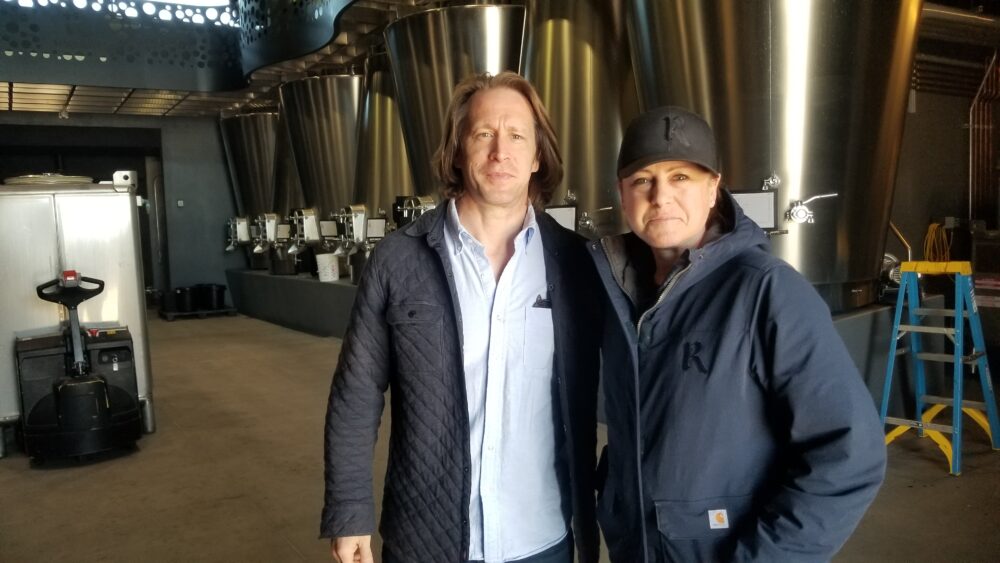
Scott Becker with winemaker Kelly Fields
I turn onto Tubbs Lane, just north of Calistoga and pull into Realm North. An exhausted-looking Chris Cooney, their Chief of Winegrowing, will be showing me around this morning. He’s been up since midnight the night before, preparing for the pick at Farella Vineyard, which began at 2:00 AM. He’s trying to be polite, and he is, but he’s also got a lot on his mind. Tall, intense, a bit gaunt, he’s bundled up in work clothes and a baseball cap. Cooney was the winegrower at Dana Estate for 10 years before joining the Realm Cellars team. At Realm, he’s more of a vigneron, applying a deep understanding that fine wine is made in the vineyard. Working closely with Realm winemaker Kelly Fields, whom I’ll meet up with later this morning, he’s keen to learn how each designate, and each block and row within each designate, performs at harvest.
He offers me a tour of the Realm North production facility. “It’s functional over fancy,” he says, walking quickly, as I try to keep up with him. He introduces me to Tyler Anthony, who is busy working the crush pad. Anthony stops to wave hello with a shut-off hose he’s holding. About three minutes in, our tour is interrupted by a beeping forklift trying to get past us. “We should probably get out of the way,” Cooney says. Instead, we head off to meet with Alvaro Torres, one of Realm’s three enologists.
Torres oversees the lab at Realm North where the Bard, among other wines, is created. The Bard is comprised of fruit from several vineyards. Numerous lots from different vineyards and from different blocks within those vineyards are kept separate while they’re fermenting. “It’s a little bit like playing a very sophisticated game of Tetris, just managing the tanks and tank space,” Cooney says.
Inside the lab, Torres and Cooney don’t waste time with pleasantries. They’re focused and ready to taste through active ferments. Daily during harvest, every single ferment across the three Realm production facilities is tasted by each enologist, who organizes the pulling of samples. Then they are tasted by Cooney and Fields. These daily tastings, during which detailed notes are taken by everyone involved, track each individual tank’s progress. They occur without fail, even while fruit is still being brought in. Days are impossibly long, with Cooney and Fields grabbing short naps here and there as they can.
Cooney is hyper-immersed when he’s tasting. Then, as if remembering I’m there, he invites me to taste alongside him. He tells me a little about what we’re tasting, but it’s as if his own words interrupt his thoughts. “This is Merlot from Farella. It’s brighter today than it was yesterday.” We move along to the next wine, and then the next one after that. “Cabernet Franc. It’s a little closed today. Hmmm.” He writes down his impressions of each wine. How a wine is faring versus where he feels it can go. Torres listens to his feedback, shares his own, and then they chat and strategize about tank space. Wanting to give them bit of space, I meet up with Realm owner Scott Becker and their chief of staff Eden Foley, who are hanging out in the Realm North tasting lounge.
Becker, 47, is a rare hands-on Napa Valley winery owner. There are winemakers who own their own brands who are certainly hands-on, but when the owner isn’t the winemaker or vineyard manager, it’s rare to find them on-site. Becker divides his time between the three Realm hubs on a nearly daily basis.
There are a few others like Becker in the Napa Valley – the Tognis of the world, the Ketan Modys, the Seth Cripes and Randy Dunns, the Matt Naumanns and the Steve and Jill Matthiassons. I consider these kinds of folks to be keepers of the flame, people who are playing the long game. They study where the region’s wines have been to better learn about continuity and specificity as they relate to a winegrowing region. Their viticultural and creative efforts are very much their own, and you won’t find them trying to copy their colleagues. And though these kinds of places are often critically acclaimed, the makers behind them are not busy chasing scores. The high scores, when they come, are icing.
Today, there are more wineries in the Napa Valley oriented toward lifestyle than, say, farming or winemaking. Of course, plenty of visitors and collectors enjoy that kind of thing, and every project adds to the narrative of Napa Valley in its own way. But, having grown up on a farm in Napa, I’m more interested in projects that prioritize their relationship to nature and their vineyard sources. These types of projects enrich the valley’s very culture and add to its historical arc. They bear a special kind of meaning and substance when it comes to a region’s core identity.
Throughout our day together, Becker will reference Napa Valley wines from the 1970s and older. He favors wines that are fresh and reflect the clonal material and soils from which they were born. He will mention his mentors, folks like Jack Cakebread, from whom he learned about the region’s agricultural history. Becker has studied each district and understands the valley’s various terroirs, topographies, macro- and micro-climates, their moods and textures. He geeks out about everything from how shifts in tectonic plates created the occasional hill along the valley floor (including Wappo Hill) to ways in which Realm has learned to save water in the cellar.
Becker implemented a water-saving innovation at Realm. Utilizing technology commonly used for other crops, Becker and his team adapted a bin cleaner that has cut water usage at harvest dramatically. Where it used to take seven gallons of water to wash one bin at harvest using a traditional hose, the newly installed bin washers use just one gallon of recycled water per bin. Becker talks about adding biodiversity back into soils and gets excited showing me new stone culverts that will divert storm waters to prevent erosion at Moonracer Estate.
There’s a vulnerability to him that is refreshing, a humility that may be due in part to his military background. Becker served as an Officer in the US Airforce for five years, where he was stationed in Afghanistan.
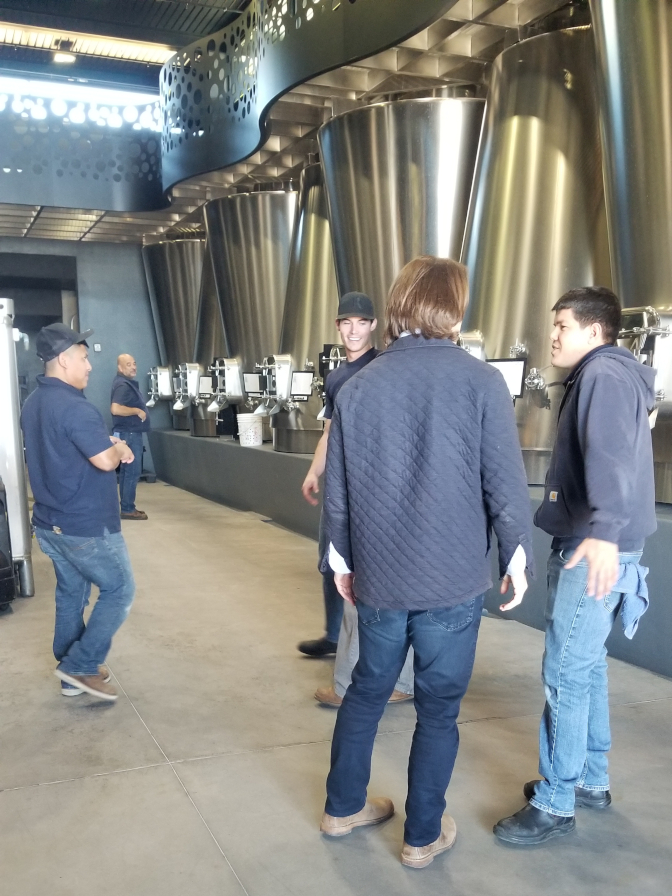
Scott Becker with the cellar crew at Houyi Estate
10:00 AM
Becker, Foley and I head out to the Houyi estate, where we’ll taste with Cooney, Fields, and Houyi enologist Alexa Hammond.
Pritchard Hill is considered a blue-chip region among wine collectors. It’s home to some of the valley’s most coveted wines among collectors: Colgin, Ovid, Continuum, Bryant Family, Chappellet, Gandona, and a few others. Aside from all of that, it’s a stunning environment. Red volcanic soils and boulders are set against a backdrop of beautiful manzanita groves, California bay laurel, and scrub oak. A heady fragrance of wild sage permeates the air. If you love the outdoors, you’ll be more impressed by the landscape up on Pritchard Hill than any of the elegant wineries and expensive homes that dot the region here and there.
The Houyi estate production facility is one such architectural wonder, though unlike many of its neighbors, it blends in nicely with the landscape and is hardly visible from afar. I meet Realm winemaker Kelly Fields. Born and raised in Napa, to parents who are also Napa natives, she has the ease and confidence of a local. Her bearing is casual and friendly, but it becomes apparent very quickly that Cooney and Hammond have high regard for her. Becker chats with the Houyi cellar team while Cooney, Fields, and Hammond head to the lab. I follow and take a seat at the end of a long, white, and impossibly clean counter where they’ll be tasting.
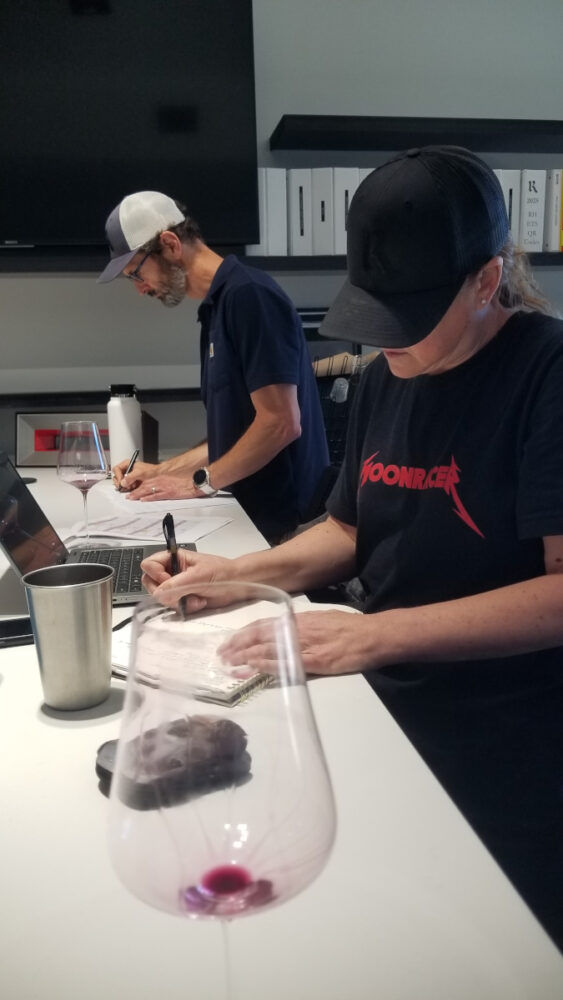
Fields doesn’t impose a commanding presence over the team and that may be why they seem to defer to her. Cooney and Hammond share their insights, with Fields listening and taking notes. There’s an air of seriousness in the room, just underneath the occasional sharing of banter and feedback.
At one point, Fields asks Cooney what his notes were for a specific lot the day before. There’s some back and forth about it, with Hammond proclaiming, “I love this wine. It’s showing a lot more fruit than yesterday.” Cooney studies his notes and says, “It’s on a smooth trajectory. Not backwards but not too forward.”
Fields identifies the next wine by calling out its tank number. Both she and Cooney agree that this next sample is missing some structure. Fields wants a few more minutes added to a pumpover. Hammond, hearing her, goes to a long whiteboard and writes down an accounting of what’s needed for this wine to reach its completion.
While Cooney and Hammond continue tasting, I tell Fields I enjoy watching the young Hammond, a 30-year-old enologist, speak up so freely around them. “I want her to have buy in,” Fields tells me. “I don’t want to make a decision without exploring the why, and I have enough humility that we can explore that why together. How else is she going to grow?”
Before joining Realm, Fields was assistant winemaker at Joseph Phelps Vineyards for just short of 18 years. “Joe Phelps liked to see people grow. I learned that from him,” Fields says of the legendary pioneer whose expansive vision helped shape the Napa Valley. Phelps, who was ahead of his time, established the Oakville Grocery Store and the Wine Service Cooperative (with Jack Davies and Chuck Carpy), where up-and-coming winemakers could store and ship wines affordably. Then, in 2000, Phelps donated land for the River Ranch Farmworker Housing Center, providing safe and affordable housing for harvest workers. Referring to Becker, Fields says, “Scott reminds me a lot of Joe in that he wants to see all of us grow, too.”
I’ll admit I’m a bit glamoured by Fields. Her no nonsense approach in the lab and cellar, balanced by a willingness to collaborate, is enchanting and I tell her so. “For me, collaboration during harvest, while working alongside the enologists and Chris, is one of the most rewarding aspects of winemaking,” she tells me. “Throughout my career, I’ve worked in teams as small as two and as large as fifteen, and no matter the size, the magic happens when everyone comes together with a shared purpose. It’s about collective problem-solving, the offering of knowledge and experience, and the shared commitment to crafting the best wines possible. True collaboration requires humility, the understanding that no single person has all the answers. And there’s a willingness to listen, learn, and adapt. There’s no room for ego, so there’s endless space for curiosity. We want to keep learning and improving.”
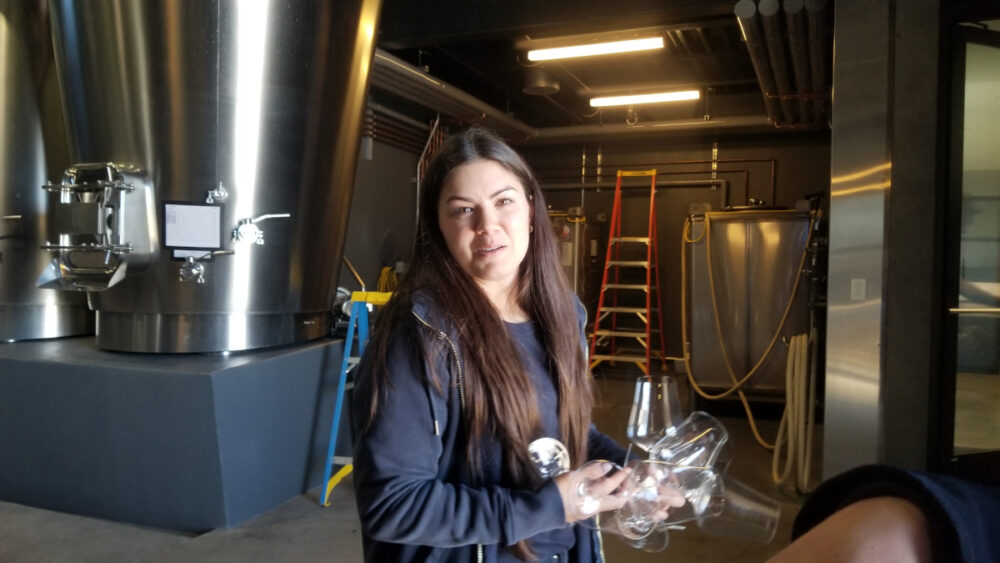
Enologist Alexa Hammond
1:00 PM
Peckish, Becker and I hop into his truck and head down the hill to Rutherford Grill in nearby Rutherford, where we’ll grab lunch. On the way, I ask him if there’s an internal hierarchy at Realm; with three production facilities, is there a sense that one of them is the focal point for the brand. Is there a flagship property within their portfolio?
“Subjectivity and nuance is everything,” he says, “including the unintended consequences of someone on the team feeling like one place within Realm is better than another place within Realm, or something along those lines. And somehow that misunderstanding could translate into the wines or the attention to detail. So, we have worked hard to try to make Realm egalitarian. To make sure they have the support they need in each location and that they’re focused at that location; that they’re not worried about what’s happening in the other places.”
And how are each of these places different, I ask him? Surely, I can tell that there are aesthetic differences at the three production facilities, but do the differences go beyond this? “The energy of each place is different,” he says, “so we have to listen to each of those places and then let the culture that informs that place influence the wines. Someone who visits Houyi is going to have a very different experience than, say, at Realm North,” he says.
Becker’s Napa Valley is not your parents’ Napa Valley, but rather, your grandparents Napa Valley. “I romanticize these Lunch Bunch gatherings that Jack Cakebread used to host,” he says, “because these lunches were literally attended by the Who’s Who of Napa Valley. Everybody would show up – Joe and Bill Phelps, Bill Harlan, Michael Mondavi, Roger Trinchero, Koerner Rombauer, John Shafer – and these guys were aligned. Now the downside of this group – something my wife has taught me over the years – was that it was mostly old white men. It was another time. But the upside was that they all knew each other. They knew each other’s kids and they all lived in the community. Now the French are buying a lot of property in Napa. I don’t mind it; I think it’s a good statement that Napa is a world class place, but crucial decisions aren’t being made by members of the community. You just think differently when you’re deciding something as someone who lives here, versus making a decision from a Paris boardroom, or someplace in New York or wherever else,” he says.
In the parking lot behind the Grill, Becker shows me a wine he’s brought for our lunch: a 1974 Freemark Abbey Cabernet Bosche – a Cabernet Sauvignon from the Bosche clone, the same clonal material found at Realm’s Hartwell XX designate in the Stag’s Leap District. Foley and Cooney meet up with us inside. I was expecting Fields to join us, but Cooney informs us she’s too busy to join in and still tasting through ferments.
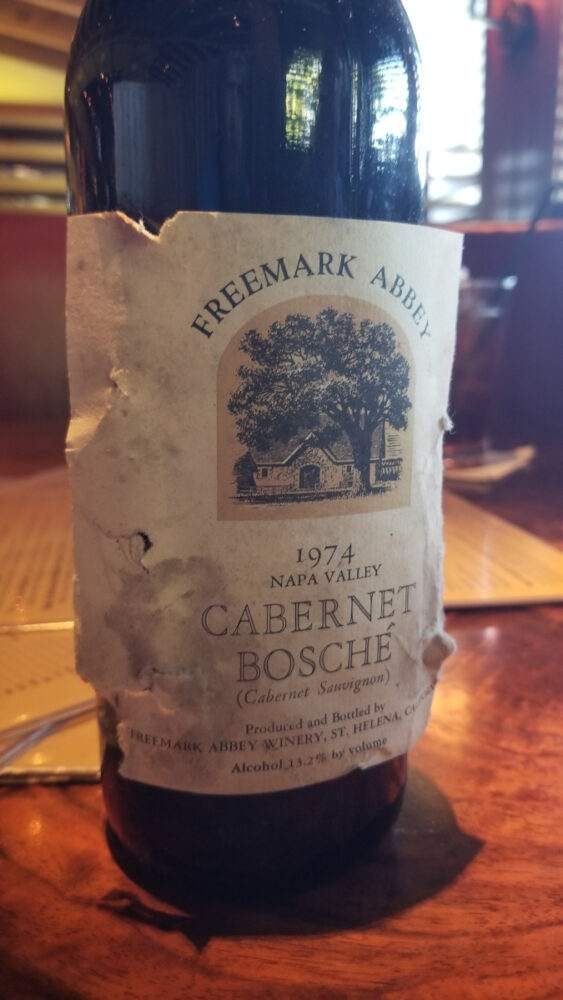
Becker asks our server to decant our wine. No matter what restaurant you’re at in the Napa Valley, chances are there is someone on staff who knows how to properly open and decant an older bottle of wine. That’s true here, and moments later, the 1974 Freemark Abbey is in a decanter, and the cork, miraculously, is in great shape. At 51 years of age, the Freemark Abbey Cabernet is remarkably fresh, with so much life still left in it. It’s a staggeringly beautiful wine; lively fruit, some tension still at play, and quite a bit of length. We’re all quiet around the table for a beat, just taking in this bit of living history before we begin perusing our menus. My Ruby Red Trout in a light lemon butter pairs just perfectly with the Freemark Abbey. There are a few runaway dregs at the bottom of an otherwise empty decanter when we disperse.
3:00 PM
I follow Cooney into the lab at the Moonracer estate, at the foot of Wappo Hill in the Stag’s Leap District. Cooney stands before a long row of tank samples. He gets to work and, once again, I taste alongside him. “Each site has its own personality,” he says. “How do we lean into that instead of trying to make everything taste the same for a score?” he asks, rhetorically. Picking up the first sample, Cooney says, “It’s softened a lot sense yesterday. This is an infant version of the ’74 Bosche we had at lunch. Same clonal material. It just needs more length.”
With the next sample, Cooney says a wine is “a little reductive, but there’s fruit on the mid- palate. It needs more time.”
He’s on a roll and will keep tasting for at least another hour, then rush home for a nap before returning later in the day to prepare for that evening’s nighttime pick. My feet are sore, I’m cold, and my shoulders are tired. Cooney gets a sense that I’m starting to feel sorry for myself and provides me with an out, which I take, and begin to close out my harvest day, even though the rest of the crew will just keep going. They’ll have two more pick dates after today and then they’ll start winding down harvest, but there will still be plenty of ferments to usher into completion. Then, the wine will need to be barreled down for élevage. They’re still weeks away from truly finishing up harvest 2025.
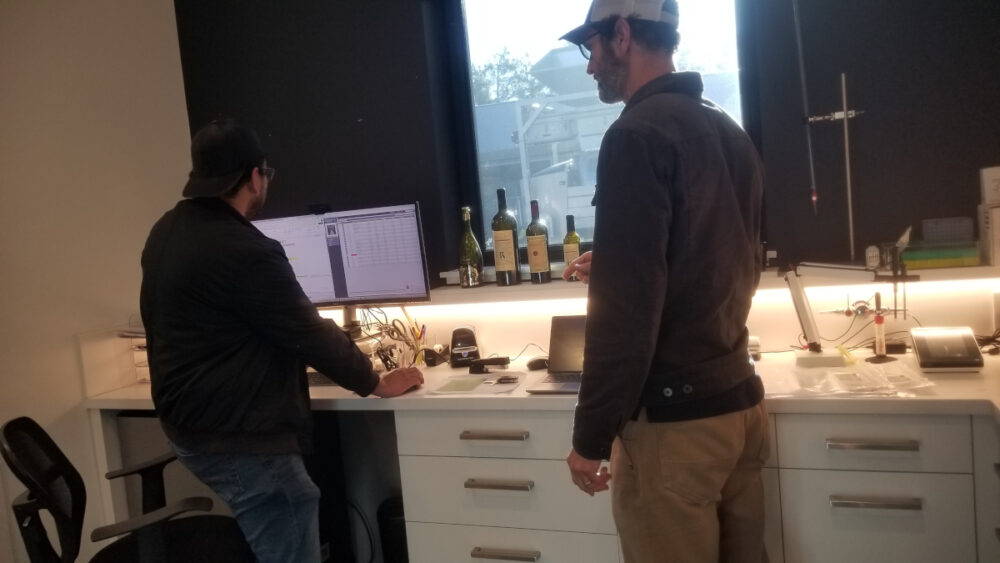
Cooney and Fields in the lab at Realm
The Tasting
The next morning, I meet up with Becker at Moonracer Estate to taste through a few wines. There’s a formal room where tastings at Moonracer are held, but Becker offers up what I’ll call the Cellar Room instead, his favorite place to hang out at Moonracer. The back wall of this room serves as a wine cellar, with world benchmarks and plenty of Napa Valley wines neatly organized behind glass doors.
The rest of the room is unassuming, with a seating area boasting a comfortable sofa and some modern, ergonomic chairs. He pours, in sequence, the following wines:
We start with the 2024 Fidelio, a lifted, bright and vibrant Sauvignon Blanc. It is full of life and a focused vitality, and it awakens my palate this morning.
Next up, we taste through a partial line up of 2023 red wines. For anyone whose been following vintages of late, especially from California, the 2023 vintage is one for the books. It provided a perfect growing season – long, cool and otherwise uneventful. Vines were allowed to ripen their fruit without duress and, in return, the fruit they gave up was textbook in its balance and characterful-ness.
In succession, we try the 2023 Houyi, 2023 Farella, 2023 Moonracer, the 2023 Hartwell XX, and the 2023 Beckstoffer To Kalon. Each wine is a study in transparency and conveys its provenance and variety of origin with immediacy and purity. If I must choose a favorite, I will say it’s the Houyi. There is a brightness and depth at its core that stops me in my tracks. It’s so pretty, unrelenting, and texturally alluring that I have the same kind of feeling in my stomach that I sometimes get when I’m in a gallery or museum and am standing before a Rothko. It’s the kind of moment that doesn’t need words of any sort. Just the presence of mind to pay attention and take it all in.